Children’s Writing Workbook – A Creative Tool for Developing Young Writers
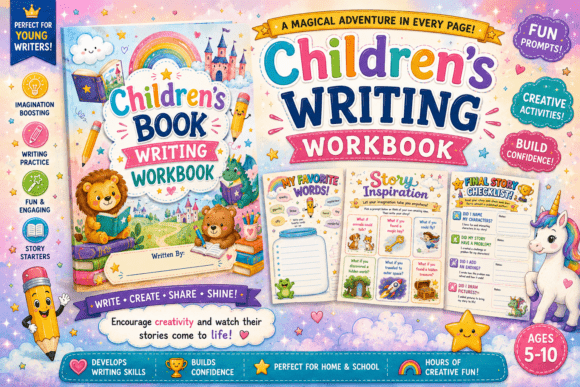
The Children’s Writing Workbook is a comprehensive resource designed to nurture the writing abilities of young learners through structured, engaging, and imaginative activities. With its 120-page format and no-bleed design, this workbook offers a blend of creativity and practicality that makes it an excellent tool for educators, parents, and homeschooling families alike. It stands out as a valuable addition to any child’s learning toolkit by combining fun with educational value in a way that supports both literacy development and self-expression.
At its core, the Children’s Writing Workbook aims to make writing an enjoyable and rewarding experience for children. Whether used in a classroom setting, at home, or during creative writing sessions, this workbook provides a structured yet flexible approach to building essential writing skills. Its thoughtful design ensures that each activity is not only educational but also stimulating, encouraging children to explore their imagination and express themselves more confidently.
Key Features That Set This Workbook Apart
The Children’s Writing Workbook includes several key features that make it particularly effective for developing young writers:
- Creative Writing Prompts: These prompts serve as excellent starting points for children to begin crafting their own stories. They are designed to spark curiosity and inspire original ideas, helping children move beyond basic sentence structures into more complex narratives.
- Story Planning Pages: Before diving into writing, children can use these pages to organize their thoughts about characters, settings, and plot elements. This step-by-step approach helps them develop a clearer vision for their stories and enhances their ability to structure their writing effectively.
- Sentence Building Activities: Through guided exercises, children practice constructing sentences, using proper grammar, and expanding their vocabulary. These activities are carefully structured to build confidence and fluency over time.
- Imagination and Creativity Exercises: The workbook encourages children to think outside the box and explore new perspectives. These exercises help foster a love for storytelling and creative expression.
- Handwriting Practice Pages: Structured writing spaces and guided lines help children improve their handwriting while reinforcing the importance of neatness and organization in their writing.
- Storytelling Worksheets: Interactive worksheets provide opportunities for children to refine their storytelling techniques. These include activities such as sequencing events, identifying themes, and understanding character motivations.
- Vocabulary Word Practice: Themed word activities and writing prompts allow children to expand their vocabulary in a meaningful way. This feature supports language development and helps them articulate their thoughts more clearly.
- Daily Writing Challenges: These challenges offer consistent opportunities for practice and encourage children to write regularly. Over time, this habit-building aspect helps reinforce learning and maintain engagement.
Who Benefits Most from the Children’s Writing Workbook?
The Children’s Writing Workbook is especially beneficial for children aged 6 to 12 who are in the early stages of learning to write. It is ideal for those who need structured guidance to develop their writing skills while also enjoying the process. Educators will find this workbook useful as a supplementary tool in their teaching curriculum, offering students a variety of exercises that align with common learning objectives.
Parents and homeschooling families can use the workbook to support their child’s literacy development in a fun and interactive way. The activities are easy to follow and require minimal preparation, making them perfect for daily use or as part of a larger learning plan. Additionally, the workbook’s focus on creativity and self-expression makes it suitable for children who may be shy or hesitant about writing.
For aspiring writers and storytellers, the Children’s Writing Workbook serves as a foundation for building strong writing habits. It introduces them to the fundamentals of storytelling, character development, and narrative structure in a way that feels natural and intuitive.
Real-World Use and Practical Value
In real-world scenarios, the Children’s Writing Workbook has proven to be a versatile and reliable resource. Teachers often incorporate its activities into lesson plans to reinforce writing concepts taught in class. For example, a teacher might use the story planning pages to guide students in creating their own short stories, which can then be shared with the class. This not only enhances their writing skills but also builds confidence and encourages peer interaction.
Parents have reported that the workbook helps their children become more independent in their writing. One parent noted that her child was initially reluctant to write but now looks forward to completing the daily writing challenges. This kind of positive feedback highlights the workbook’s effectiveness in making writing an enjoyable and rewarding experience.
From a practical standpoint, the workbook’s no-bleed format ensures durability, making it suitable for repeated use. The clear instructions and organized layout make it easy for children to navigate on their own, reducing the need for constant parental supervision. This independence is crucial for developing self-directed learning habits.
Quality, Usability, and Long-Term Value
The quality of the Children’s Writing Workbook is evident in its well-thought-out design and content. Each page is carefully crafted to balance educational value with entertainment, ensuring that children remain engaged throughout the learning process. The use of colorful illustrations and varied activities keeps the material visually appealing and prevents monotony.
Usability is another strength of this workbook. The activities are straightforward and do not require specialized materials or equipment. All that is needed is a pencil and some imagination. This makes it accessible to a wide range of users, regardless of their location or resources.
In terms of long-term value, the Children’s Writing Workbook offers lasting benefits. By consistently practicing writing through structured activities, children develop a strong foundation in literacy that can support them throughout their academic and personal lives. The skills they acquire—such as storytelling, vocabulary expansion, and critical thinking—are transferable to various subjects and future endeavors.
While the workbook is primarily designed for younger learners, its principles can be adapted for older students or even adults looking to refine their writing skills. This adaptability adds to its long-term value and broadens its potential audience.
Final Thoughts
The Children’s Writing Workbook is more than just a collection of writing exercises—it is a comprehensive tool that supports the development of essential writing skills in a fun and engaging way. Whether used in a classroom, at home, or as part of a homeschooling curriculum, it provides children with the opportunity to explore their creativity, build confidence, and improve their literacy skills.
Its structured yet flexible approach makes it suitable for a wide range of users, from educators and parents to young learners and aspiring writers. With its emphasis on imagination, storytelling, and self-expression, the Children’s Writing Workbook stands out as a valuable resource that fosters a lifelong love for writing.